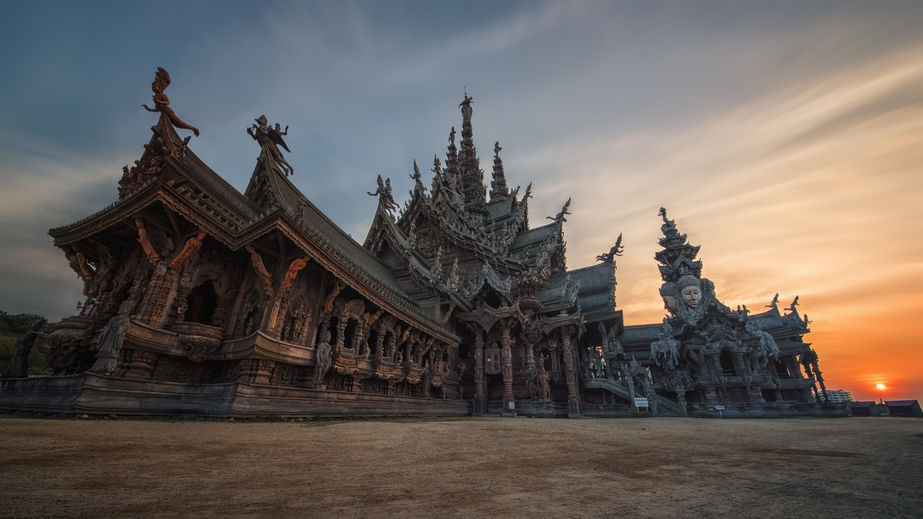
When I visited Ancient Siam, I was already fascinated by the model of the Sanctuary of Truth, which is made entirely of wood. Now that I was nearby, I really wanted to see it in its full size, explore it, and experience it for myself. After all, this “palace” is over 100 meters high and just as long and wide.
The purpose of the Sanctuary of Truth in Pattaya is to use its art to highlight the importance of religious philosophies that teach people to do good and avoid doing wrong. Wikipedia describes it as a monument and considers it to be the largest wooden complex in Thailand, built in the architectural style of the Rattanakosin period. Great, let’s go take a look.
A disappointment at first
Of course, I rode there by bike – and was disappointed at first when I rode through the gate in the medieval-looking wall. My first impression was, well, somehow a bit empty. There was a parking area with an inconspicuous covered area where I was supposed to pay the entrance fee. And this was supposed to be the amazing, gigantic wooden castle?
A pony-riding area, a few climbing structures for school groups, and the obligatory kiosks all looked unimaginative, almost neglected.
Then came my first glimpse of the Sanctuary of Truth
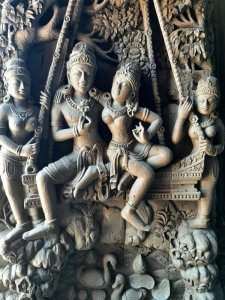
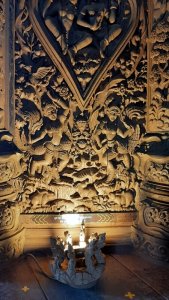
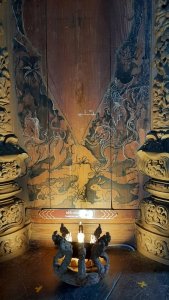
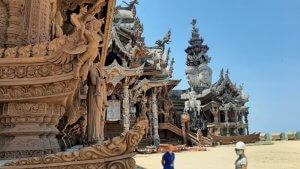
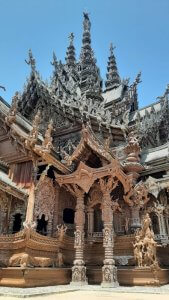
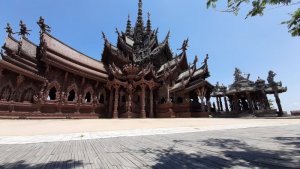
This, however, made the contrast even more striking when I got my first glimpse of the temple-like wooden structure from the meeting point for the guided tours. The Sanctuary of Truth is built directly on the beach. The sea and horizon provided a perfect backdrop for the incredibly intricate carvings, supports, and curved roofs. Figures from mythology seemed to float above the peaks and rooftops, as if they wanted to fly across the sea toward the sky.
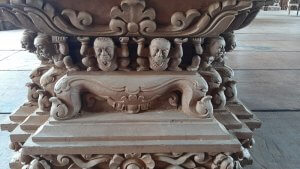
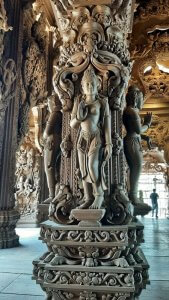
In contrast, the building itself looked heavy. Everything is covered in carvings, which at first makes it appear more massive than delicate.

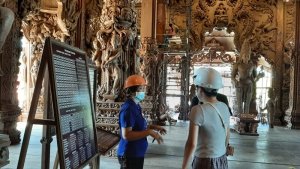
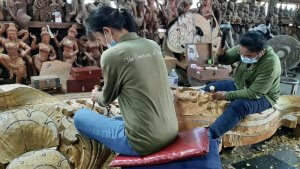
Our guide first led us through the workshops, where various elements were being worked on before eventually being installed inside the building. As we made our way around half of the building, I had to stop again and again. There was simply far too much to discover for me to just keep following her.
Special Features
The different types of hardwood are treated with acids before being installed to protect them from harmful environmental factors such as the sea and termites.
Metal connectors are used only during construction. Once completed, the entire structure is built without any metal, using traditional joining techniques such as mortise-and-tenon joints, wedge joints, butt joints, dovetail joints, and similar methods.
600-year-old Takien wood was used for the main support beam.
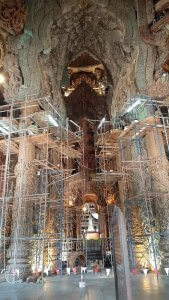
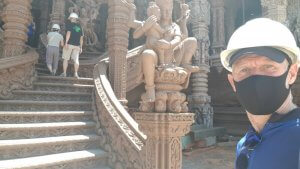
Similar to the White Temple in Chiang Rai (or the Sagrada Familia in Barcelona), the whole complex is still under construction and will be for quite some time. The carvings are so incredibly detailed that even with dozens of skilled craftsmen working on them, they cannot be completed quickly.
On one side, large faces look out in all four directions from around a pagoda-like tower. It strongly reminds me of Angkor Wat. No wonder, as we were told that the design of this section was influenced by Cambodian architecture, while other parts were influenced by Chinese or northern Thai styles.
Visual Overload
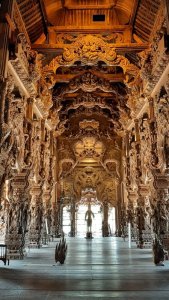
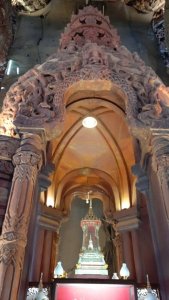
Inside, I was overwhelmed by the sheer size and the endless variety of decorations. A cathedral made entirely of wood. In many areas, there were scaffolds, while craftsmen hammered and sanded away. Some kind of meditation music played in the background. I listened only half-heartedly to the explanations about the four main elements in the entrance hall.
I also didn’t pay full attention to the descriptions of the Bodhisattvas – the enlightened beings – from Chinese history. Although I came across an old acquaintance from Chiang Rai, Guanyin, I was far too distracted by the visual overload.

It was almost at the end that it finally struck me. The large throne – actually a kind of pavilion – in the center of the complex moved me deeply. In the midst of all this splendor, the interior of this resting place for Buddha relics is completely simple and unadorned. It is meant to symbolize that we leave this world with nothing. We cannot take anything with us when we die. In the spirit of Buddha’s teachings, it represents the emptiness of the universe, or Nirvana.
The Meaning and Message Behind It
I was very lucky. At the end of the nearly hour-long tour, the lunch break began. The already small number of visitors left the building along with the workers. I stayed behind in the quiet and was able to take my time appreciating everything all over again.

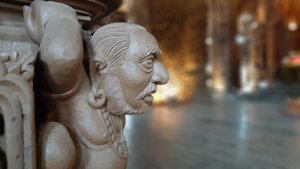
The Sanctuary of Truth is meant to be a message, a school for our inner alignment and a school for peace within us. So everything visible here has a meaning. Every relief, every column and every statue is meant to inspire us, to bring us to reflection and to inner awareness.
In 1981, the founders, Lek Viriyahbhun and his wife, Prapai, began construction. They recognized that rapidly advancing technology and globalization, along with the pursuit of wealth and social status, were placing enormous pressure on us. As a result, the meaning of life gradually disappears and chaos begins. Through the art of the Sanctuary of Truth, they wanted to show future generations that it is still possible to live in peace by reconnecting with the nature of human life.
The four different rooms encourage us to reflect on the following:
- The four elements – all life is based on water, fire, earth, and air.
- Social and Spiritual Growth – following Mahayana Buddhism, people can develop and grow by doing good deeds.
- Astrology – the sun, moon, and planets have an influence on human life.
- Selfless Love from Mothers and Fathers – it is what distinguishes us from other living beings and inspires gratitude.
And? Does the Sanctuary of Truth achieve its goal?
As I looked around during the tour, I mostly saw tourists posing for selfies or moving relatively quickly from one hall to another. I didn’t get the impression that anyone was stopping to pause and reflect or allowing themselves to be touched by the message of the complex. But who can really know what goes on inside someone else?
A large group of students, around 11 or 12 years old, came in after me, kept in check by their strict teachers. What will they take away from this place, which aims to inspire people to live a better life in harmony with the nature of life?
This place touched me. Something stayed with me. I am not only impressed by the power of the founders’ vision, but also by a message that feels more relevant to me than ever. If every visitor takes even a little bit of that message with them, the world will become just a little bit better.
But anyone who travels through Thailand with an open mind will see a people and their children increasingly consumed by social media. How can we preserve our inner balance in times like these and resist the drug of constant distraction?

Good to Know
- Entrance fee: 500 baht
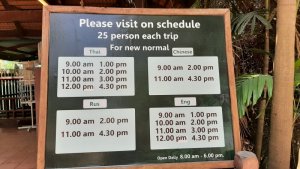
- Guided tours in four different languages – Thai, Chinese, English, and Russian – are included in the entrance fee. Tours take place every hour between 9:00 a.m. and 3:00 p.m., with a final tour at 4:30 p.m.
- Interestingly enough, visitors are required to wear helmets inside because it is still a construction site.
- Private drone flights are not allowed on the area.
How to Get There?
The Sanctuary of Truth is located in Pattaya on Rachvate Road, north of Pattaya Beach in the Naklua area. It is approximately 120 km from Suvarnabhumi Airport. From the airport, as well as from the Ekkamai Bus Terminal, there are direct buses and minivans to Pattaya. Minivans for up to 9 people cost between 200 and 300 baht. A private shuttle costs around 2,000 THB. It’s best to check 12Go for the latest connections.
Travelers with their own vehicle can follow Google Maps and the signs from Highway No. 3. Songthaews stop along Naklua-Pattaya Road, about 1.5 km away. Motorcycle taxis and regular taxis are also easy to find.
The official address is:
206/2 Moo 5, Soi Naklua 12
Naklua, Banglamung, Chonburi 20150
Very nice hotel
I stayed in Jomtien. It has a long beach, a waterfront promenade, plenty of restaurants and cafés, and good infrastructure.
I really liked the boutique hotel SeaCreast. It’s only 100 meters from the beach and waterfront promenade, but that also makes it a little quieter. I had a sea view from my balcony and loved the hotel’s unique design. I probably got it at an unbeatable price because I stayed there during the COVID period and outside the peak season.

My tip: Compare prices on Booking.com and Agoda. One of the two is usually cheaper.
You might also be interested in:
MyDroneThailand – Drone registration service
5 Top Tips for SUVARNABHUMI AIRPORT Bangkok
My tips for you: trips in Chiang Rai province
Comparison of Bangkok Airport Hotels