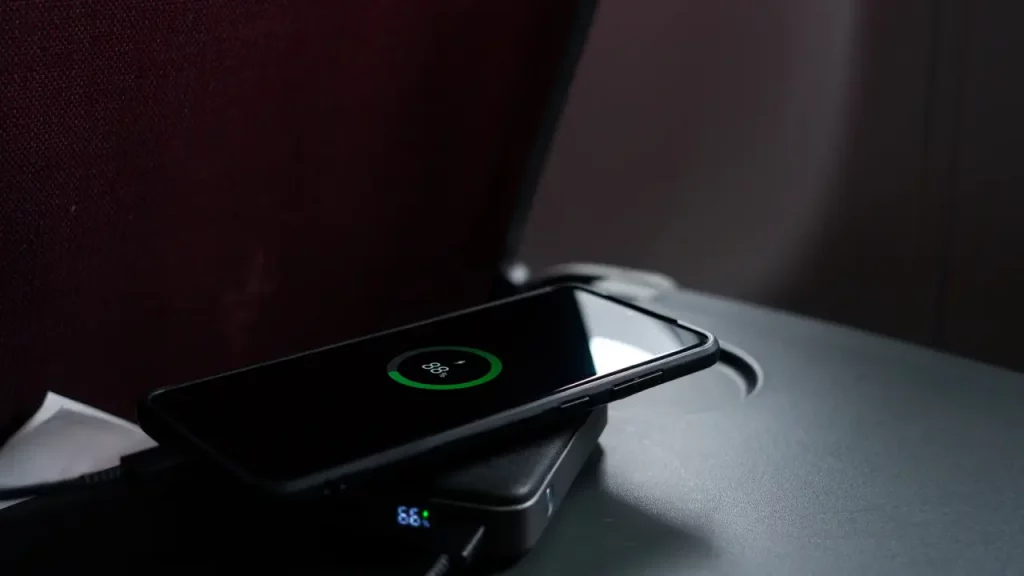
Nowadays, almost everyone flying to Thailand carries a power bank in their luggage. While it’s a convenient travel essential, airlines consider it a safety concern, and the regulations have become significantly stricter since 2026. Here’s a summary of what you need to know before flying with a power bank.
- Basic Rule: Power Banks Must Be Carried in Hand Luggage Only
- Watt-Hours Instead of Milliamp-Hours: Understanding the Limits
- Why the Rules Have Become Much Stricter
- Current Airline and Thailand Regulations
- What This Means for Using Power Banks On Board
- Tips for Getting Through Airport Security
- My Experience from My Recent Flights in July 2026
- In Summary
Basic Rule: Power Banks Must Be Carried in Hand Luggage Only
Power banks contain lithium-ion batteries and are officially classified as Class 9 dangerous goods by the IATA (International Air Transport Association). As a result, a clear rule applies worldwide: power banks must be carried in your hand luggage only and must never be packed in checked baggage. In the cargo hold, it would be much more difficult to respond quickly if a battery were to overheat or catch fire.
TIP: If your carry-on luggage has to be checked at the gate because the overhead bins are full, make sure to remove your power bank beforehand and keep it with you.
Watt-Hours Instead of Milliamp-Hours: Understanding the Limits
When it comes to carrying a power bank on a flight, the important value is not its capacity in milliamp-hours (mAh), but in watt-hours (Wh). To calculate watt-hours, multiply the mAh rating by the battery voltage (usually 3.7 volts) and divide by 1,000. For example, a 20,000 mAh power bank has a capacity of approximately 74 Wh.
Formula: Voltage (V) × Capacity (mAh) ÷ 1,000 = Wh
Grundsätzlich gilt:
| Battery Capacity | Carry-on Baggage | Checked Baggage | Approval Required? |
|---|---|---|---|
| Under 100 Wh | ✓ Allowed | ✗ Not Allowed | No |
| 100–160 Wh | ✓ Normally Allowed | ✗ Not Allowed | Airline Approval Required |
| Over 160 Wh | ✗ Prohibited | ✗ Prohibited | Generally Not Allowed |
In addition, flights within or to Thailand are now subject to a limit of no more than two power banks per person, regardless of their capacity. If the capacity label is no longer legible, your power bank may be confiscated during security screening, even if it would otherwise comply with the regulations.
Why the Rules Have Become Much Stricter
The latest tightening of the rules was triggered by an incident in early 2025, when a power bank stored in an overhead compartment on board a South Korean Air Busan flight reportedly caught fire shortly before takeoff. Additional incidents followed, including cases involving Thai AirAsia and, in July, Bangkok Airways, where an overheating power bank forced the aircraft to divert to Bangkok. In response, the Civil Aviation Authority of Thailand (CAAT) updated its regulations in May 2026 to align with the now widely adopted international standard, limiting passengers to two power banks and prohibiting charging them during the flight.
Current Airline and Thailand Regulations
The Lufthansa Group—including Lufthansa, SWISS, Austrian Airlines, Brussels Airlines, Eurowings, Discover Airlines, and Air Dolomiti—tightened its regulations on January 15, 2026. Power banks with a capacity of up to 100 Wh are still permitted on board, but they may no longer be used or charged during the flight, whether to power your own device or via the aircraft’s power outlets. The only exception is for approved medical devices.
Thailand has also introduced stricter regulations. Since March 27, 2026, Thai Airways has completely banned the use of power banks on board, although passengers may still carry up to two power banks in their hand luggage.
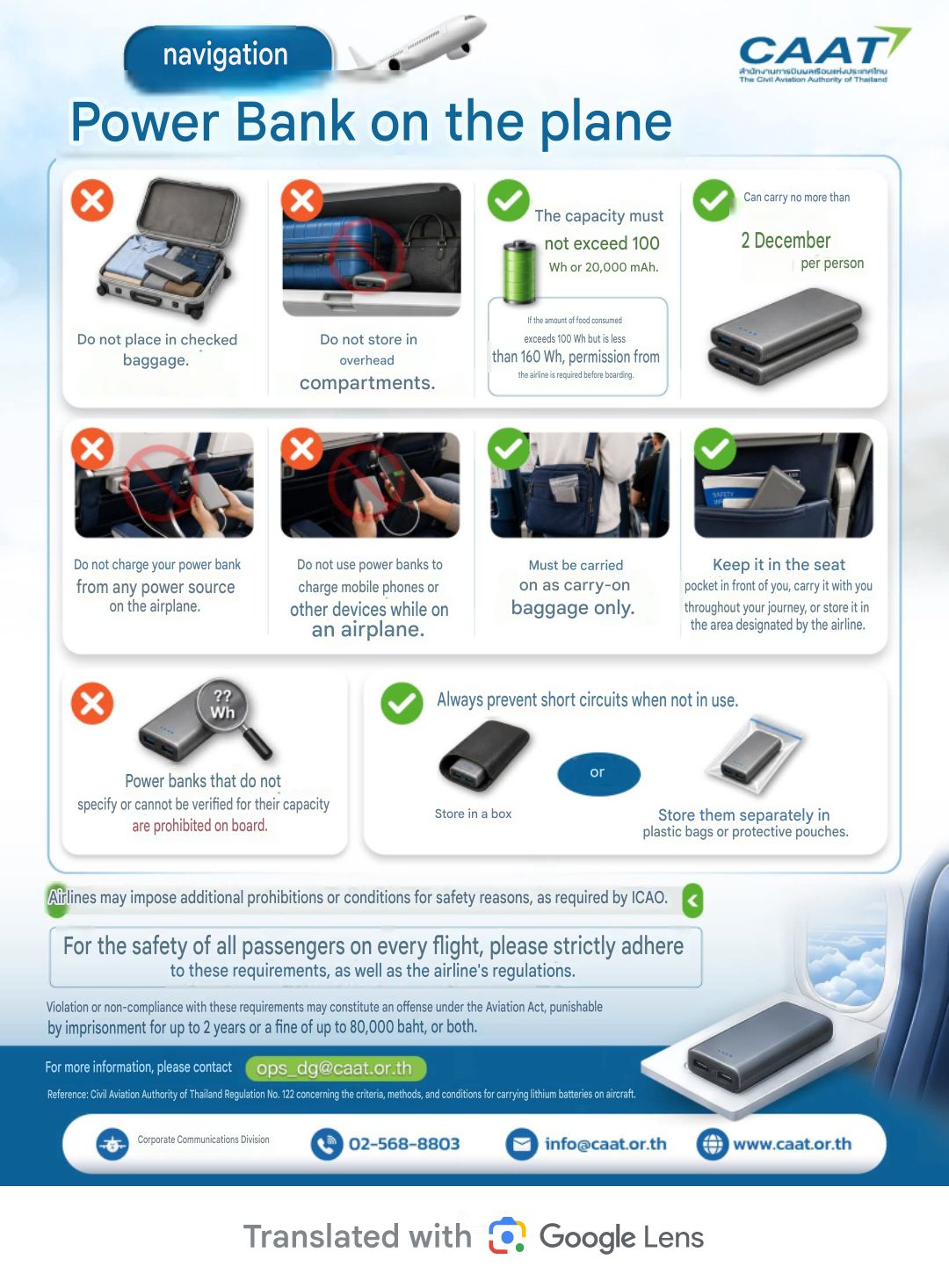
On June 4, 2026, Thailand’s Civil Aviation Authority (CAAT) introduced its own regulation, making these rules mandatory for all flights to and from Thailand, in line with ICAO guidelines. Power banks must be carried in hand luggage only, with a maximum capacity of 100 Wh (approximately 20,000 mAh) without prior airline approval. They may not be used during the flight or stored in the overhead compartment above your seat. Similar restrictions have also been introduced by Korean Air, Asiana Airlines, EVA Air, China Airlines, Singapore Airlines, and several airlines in Japan.
Here is the CAAT infographic translated using Google Translate:
What This Means for Using Power Banks On Board
The biggest change compared to previous regulations is that, while many airlines still allow you to bring a power bank on board, you are no longer permitted to use it to charge your phone, tablet, or other devices during the flight. Charging the power bank itself via the aircraft’s power outlets is also prohibited.
The safest place to keep your power bank during the flight is somewhere easily accessible, such as in the seat pocket or in a small bag stored under the seat in front of you—not in the overhead compartment.
I experienced this myself on my most recent flights with Qatar Airways and Thai Airways. The rules were enforced quite strictly, and I saw fellow passengers being reminded not to use their power banks after they started charging their devices during the flight.
Tips for Getting Through Airport Security
- Keep your power bank easily accessible, preferably in a separate compartment of your bag.
- Make sure the capacity rating printed on the power bank is clearly visible and legible.
- Bring no more than two power banks and leave any extras at home.
- Protect the terminals, for example by using the original packaging or covering them with tape.
- If you’re unsure, check with your airline in advance, as the specific rules may vary depending on the airline and route.
My Experience from My Recent Flights in July 2026
During my flights in July 2026, I noticed that these rules are now taken very seriously. Both at the airport and during boarding, passengers were specifically reminded about the power bank regulations—sometimes through public announcements and sometimes directly by staff at the gate.
My impression is that what used to be a small note on an airline’s website just a few months ago is now being consistently enforced. If you travel without knowing the current rules, you could face delays at the gate or, in the worst case, have your power bank confiscated.
In Summary
- Carry your power bank in your hand luggage only—never in checked baggage.
- Up to 100 Wh is allowed without approval; 100–160 Wh requires airline approval; over 160 Wh is prohibited.
- A maximum of two power banks per person is now the standard on most airlines.
- Using or charging power banks during the flight is completely prohibited by many airlines.
- The capacity rating must be clearly legible; otherwise, your power bank may be confiscated at the gate.
Note: Airline regulations continue to change and may vary depending on the airline and destination country. Always check your airline’s latest guidelines before you travel.
You might also be interested in:
MyDroneThailand – Drone registration service
5 Top Tips for SUVARNABHUMI AIRPORT Bangkok
My tips for you: trips in Chiang Rai province
Comparison of Bangkok Airport Hotels